
- How Did They Do It?Continue reading →
How Did They Do It?
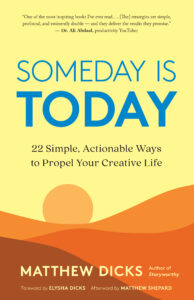
An Excerpt from Someday Is Today by Matthew DicksI was running on a treadmill at Bally Total Fitness in West Hartford, Connecticut, back in the spring of 2005 when my life was changed forever. I had just abandoned my third attempt to write a novel — a ridiculous story about a teenage savant and his pet ferret (no joke) — and was finally coming to terms with the reality that I would never become the novelist I had always wanted to be.
As hard as I tried, I just couldn’t write good fiction. I’ll write for magazines, I told myself. Try my hand at a memoir. Maybe write a book on teaching. Wait for the day when a newspaper editor might offer me a weekly column.
I was saddened by the thought that my dream was dead, but I was also ready to move on to something more fruitful and realistic. Forward motion. It made sense.
As I ran, I was listening to Stephen King narrate On Writing, his seminal tome on writing well. King was talking about the early days in his career, when he was writing stories for men’s magazines and getting paid tens and hundreds of dollars at a time.
King was also a teacher, much like myself, earning $6,400 per year. His wife was working for Dunkin’ Donuts. Between their two salaries and their two children, they were barely making ends meet. Living in a double-wide trailer. Unable to afford a phone. Unable to afford medication for their kids. Desperate times for two young parents, both of whom had dreams of publishing novels someday. King wrote:
The problem was the teaching. I liked my coworkers and loved the kids — even the Beavis and Butt-Head types in Living with English could be interesting — but by most Friday afternoons I felt as if I’d spent the week with jumper cables clamped to my brain. If I ever came close to despairing about my future as a writer, it was then. I could see myself thirty years on, wearing the same shabby tweed coats with patches on the elbows, potbelly rolling over my Gap khakis from too much beer. I’d have a cigarette cough from too many packs of Pall Malls, thicker glasses, more dandruff, and in my desk drawer, six or seven unfinished manuscripts which I would take out and tinker with from time to time, usually when drunk. If asked what I did in my spare time, I’d tell people I was writing a book — what else does any self-respecting creative-writing teacher do with his or her spare time? And of course I’d lie to myself, telling myself there was still time, it wasn’t too late, there were novelists who didn’t get started until they were fifty, hell, even sixty. Probably plenty of them.
I slowed my pace as King read that passage aloud. By the time he had reached the end, I’d come to a complete stop. I couldn’t believe it. Stephen King was talking about me. Talking to me. Absent the alcohol and cigarettes, I was coming perilously close to despairing about my future as a writer, too.
Like King, I was giving up.Around that time of despair, King tossed his unfinished manuscript of Carrie into the trash, finding the story to be full of unfillable holes. He gave up on the story. Decided to move on to something else. But King’s wife Tabitha removed the pages from the trash bin, read them, and told King to keep writing. She liked it. She saw potential where her husband had seen nothing but holes.
When he finally finished writing the book, it was the fourth novel he had completed. His previous three novels — Rage, The Long Walk, and The Running Man — would all eventually be published. But Carrie was the first. It represented his first big break.
King received a call from his wife one day while teaching at school, informing him that Doubleday had made an offer on Carrie : $2,500. Not a lot even by 1970s standards, but a publishing contract nonetheless. A much-needed break.
The paperback rights for Carrie would later sell to Signet for $400,000. A lot of money by any standard.
Listening to King talk about his journey, something shifted inside me. Standing on a treadmill in a Bally Total Fitness that no longer exists today, my life had changed in an instant. I suddenly saw a path to making my dreams come true. Someone not unlike me — a teacher with the dream of publishing a novel but despairing about his writing career — had found an unlikely path to success.
If Stephen King, formerly of a double-wide, telephone-free trailer, could do it, so could I. All I needed to do was keep writing. So I did. The path to my first novel was a circuitous one. It included two more false starts and nearly a year of writing Dungeons & Dragons adventures at the behest of my friend Shep, who perhaps recognized my need for an audience.
But almost exactly two years after that moment on the treadmill, in the spring of 2008, I received my life-changing phone call, also while teaching at school. It wasn’t my wife who was calling — she was teaching in a classroom two doors down the hallway — but my literary agent, telling me that Doubleday had made an offer on my first novel, Something Missing. More than $2,500, too. Enough to pay off our wedding debts and put a down payment on a house.
Crazy, right?
Stephen King and Matthew Dicks, both at school, both in the midst of teaching careers, when a phone call changed our lives. Both with offers from Doubleday.
Thank goodness Stephen King wrote On Writing. I found it just when I needed it.
Matthew Dicks is the author of Someday Is Today and nine other books. A bestselling novelist, nationally recognized storyteller, and award-winning elementary schoolteacher, he teaches storytelling and communications at universities, corporate workplaces, and community organizations. Dicks has won multiple Moth GrandSLAM story competitions and, together with his wife, created the organization Speak Up to help others share their stories. Visit him online at www.MatthewDicks.com.
Excerpted from the book from Someday Is Today: 22 Simple, Actionable Ways to Propel Your Creative Life. Copyright ©2022 by Matthew Dicks. Printed with permission from New World Library.
- Double Vision: Praying for the Dearly DepartedContinue reading →

Do you believe that praying for those who have passed away has an effect on them? Do spirits find comfort in the prayers of the living? Do they know we love them?
Heather
Susyn:
I absolutely believe that praying for our deceased loved ones has an effect on them, and that they deeply appreciate it. We can always connect with the spirits of those who have passed, though it is sometimes difficult to know if they can hear us. Whether we pray for them, converse with them, or simply grieve for them, we are connecting with them on a spiritual level.
Some people believe that when we die, we cross over into
heaven,
where all our problems are solved or left behind on the earth plane for others to deal with. Nothing could be further from the truth: If we pass over with unresolved issues, negative feelings, resentments or regrets, we will be required to continue working on them in the spiritual dimension.It is helpful to send departed loved ones our prayers to help them with all of this. Though health and financial problems have been left behind, emotional and spiritual ailments still need to be healed. Keep in mind that it is more difficult to work on these issues from the other side, so our prayers for our loved ones are greatly appreciated.
Think of a prayer as a ball of energy. When we say a prayer for someone else, we ask for things that would be in their best interests. Every time we channel our attention toward something, it grows stronger. This is how our prayers help people who have crossed over to move forward; our prayers give them a sense of strength and energy so that they can do what they need to do.
Praying for the dead is no different than praying for someone in a foreign country who is fighting a war or suffering from a health problem. Whether they can see or hear us or not, the prayers we send help them in ways we might never imagine.
If you have recently lost a loved one, you are most likely praying that they have made it to the other side safely, that they are all right. You can rest assured that any health problems and physical pain they suffered have been completely left behind. If you know of other specific concerns, you can focus on those. For example, if they left unfinished business with a loved one or were in conflict with a relative when they passed, you may want to pray that the issues of their heart are resolved.
As you pray, remember to include moments of silence in your thoughts, for often our loved ones will reach out and try to communicate with us when we are focusing on them. You may be surprised at what they have to say!
While our friends and family who have passed away do know that we love them, through prayer, we can actively remind them of how much we treasure and miss them.
*****
Oceania:
Your question triggered a memory from my college days. I had a psychology professor with a perpetual twinkle in his eye. He was kind, humble and humorous, and his lectures were always captivating. When they ended, spontaneous applause would sometimes erupt. On one such occasion, he shouted,
I don't need your approval!
Then he smiled and added,...but I sure do enjoy it!
I think your departed loved ones would say something very similar. Their perspective is now one of greater wisdom and understanding, so while they don't need your prayers, they sure do enjoy them! An added bonus is that your prayers are good for YOU! We have countless options for where to focus our mental attention in any given moment, and some are better for us than others. Whereas worry and regret pull us down, loving thoughts uplift us and support our well-being.
When my elderly father first got satellite TV, he would sit back and use his remote to flip through the hundreds of available channels to see which program he'd like to watch. He complained that he was at the mercy of too many options because by the time he got through them all, the hour was over. I suggested that he proactively choose a genre like sports, religion, old movies or news, and narrow his search within that field. This is similar to narrowing the focus of our mental field and then choosing exactly what to think about. Counting our blessings, affirming and envisioning our desires, and prayer are all
premium channels
of thought!As I was getting to know my retired neighbor, she shared with me that on most days, she writes a letter of gratitude by hand on pretty stationary. She adorns the envelope with a Love stamp and cheerful stickers before dropping it in the snail mailbox. Sometimes she writes to family and friends, but more often she writes to people she doesn't know in order to thank them for affecting her life in a positive way. She has written to the president and other officials, to the local library and fire station, and even to authors of books she has read.
If she asked me, as you did, whether I thought her letters mattered to those on the receiving end, I would say,
Of course!
I'm confident her recipients, like those who hear your prayers, sincerely appreciate her efforts.I also think that the person who benefits most from the process is her! Pausing to give thanks through letters or prayers is one of the best things we can do for our spiritual and emotional health, so carry on! Your departed loved ones want you to make the most of your remaining time on earth.
Astrea:
Many times in life we hear, "You will always have what you NEED, but not necessarily what you WANT." Your spirit must have needed to experience the feeling of leaving your human body, and the suggestion in the next chapter of Sylvia Brown's book was all it took to get you there.
Even though you hadn't read it yet, your SOUL recognized the title of that chapter as something it had been seeking, and your soul, knowing that you had that reference to read after your experience, got with it and out you went!
While I don't usually recommend her books, Sylvia Brown has a wide reaching and powerful effect on lots of people. A Gemini like you would be able to relate easily to her writing and put it to good use. Synchronicity - you gotta love it!
I like your description of "getting caught." That's exactly what it feels like, isn't it? One minute you're free and hovering above the room, and the next minute, ZAP! back down into your corporeal form you go!
As a little kid, I loved that "feeling of return." With practice, most of the time we can control that event, but sometimes, when our physical ears hear a distracting noise or something else occurs to knock us back into reality, back we go. With practice you will be able to control your return better.
I find it interesting that you were visiting your mother-in-law and not someone in your own genetic family. Evidently, you and your husband got married for reasons that are even deeper than love. His family's interest in "psychic stuff" will nurture your children in such matters and help them to grow into their own abilities.
You'll never have to be concerned that when your daughter visits them, she'll be discouraged from exploring her own psychic life and power. My parents encouraged me to develop my psychic senses in a time when it wasn't nice to even discuss such things in public. Heck, it's STILL not considered a great topic at the dinner table in some families!
Your kids will get to talk about it ALL and ask questions and read and study. This is going to give them such an edge in life! Talk with your husband about how you want to present this to your kiddos, so that you are united in your approach and ready to tell them their experiences are all natural and okay.
A word or two of warning: Geminis often have difficulty staying grounded in REAL LIFE. Don't get so strung out on your ASTRAL life that you neglect what you're doing here on Earth.
You are at the beginning of a long journey to learn where your power really lies. Try to be patient with this process and take your time.